     |
|
|
 |
|
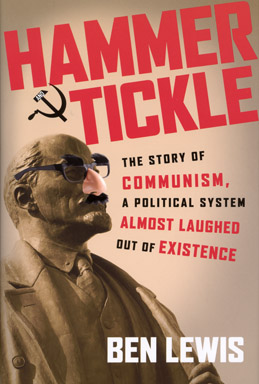
A daringly fresh and original history of communism as told through subversive jokes Communist jokes are the strangest, funniest, most enchanting and meaningful legacy of the eighty years of political experimentation in Russia and Eastern Europe known as Communism. The valiant and sardonic citizens of the former communist countries—surrounded by an invisible network of secret police, constantly threatened with arrest, imprisonment, and forced labor, and confronted by an economic system that lefts shops empty, all the while bombarded with ludicrous propaganda—turned joke-telling into an art form. Humor was a coded way of speaking the truth and coping with grim reality. Hammer and Tickle takes us on a unique journey through the communist era and shows us what the average citizen truly thought about Lenin, Stalin, the Stasi, even Gorbachev. These jokes and cartoons often resulted in a one-way ticket to the gulag, but it never stopped the laughs from Warsaw to Leningrad as people exchanged witticisms and found solace through shared humor. Culturally poignant and historically revealing, including previously unpublished cartoons, photographs, and caricatures, Hammer and Tickle recounts the tragicomic story of a political system that was (almost) laughed out of existence. |
|
Advance Praise for Hammer and Tickle
"Marvelously original.... A fine tribute to the joyous, humane
anarchy of laughter, whose nearest political analog is that
ramshackle, chaotic system of political wishful thinking called
democracy. And my favorite joke? 'What stage comes between socialism
and communism? Alcoholism.'" "Entertaining and thoughtful.... Explores
the wealth of subversive humor during the long, bleak decades of
communism." "Charming, highly
original, elegantly written and a valuable piece of cultural
history. This is a very funny book. Like the best communist jokes,
it is funniest when it is grimmest." "We find at long last the
jokes only communism could produce. And while they may not have
brought it down, they can still tell us something important about
why it fell." |
|
Table of Contents
Acknowledgements |
|
Foreword I have not taken many liberties with this book, but any book about jokes and Communism that reaches across countries and eras must take some. First I have chosen to use the Western term for the political system of the Soviet Union and Bloc, Communism, rather than the word they used themselves in this period, Socialism. Socialism is, I agree, a nicer word, but carries the second meaning of an ideology that is still extant in Europe. Second, I have given the term 'Communist jokes' to what could more precisely be described as anti-Communist or anti-Soviet jokes—this is because I think the looser term better captures the sense of shared culture. The jokes in this book are historically documented, but, since everyone tells jokes in their own way, I have permitted myself to rewrite many of them in my own style. There are a significant number of Communist jokes which rely on puns that cannot be translated into English from their various original languages and, since a joke loses most of its wit when it requires explanation, I have decided to omit these. The jokes in this book come from European Communist societies and Russia. For whatever reason the same phenomenon didn't exist in the same way in South East Asia or China. I've made little mention of the Communist jokes of Yugoslavia, because they were identical to those told in the rest of Communist Europe. I've also left out Cuban Communist jokes because for the most part they weren't produced by Cubans living in Cuba. This is not an all-encompassing compilation of all Communist jokes. I have used the jokes to illustrate my story and argument, and many, even some of the best, have been left out—like the one about the old Jew on his deathbed who asks the rabbi, as his dying wish, to be made a member of the Communist Party, because 'It's better that one of them dies, than one of us.' I hope the reader will pardon these gaps, simplifications and short cuts in my text. |
 |
|
About the Author BEN LEWIS directed the award-winning film Hammer and Tickle. He is a writer for Prospect magazine in London. |
|
|